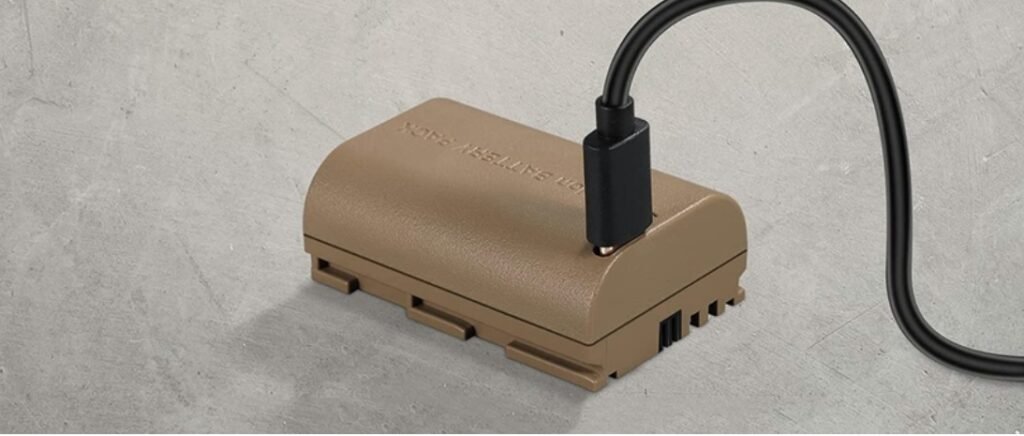

For years, charging a camera battery meant one thing: take the battery out, find the cradle charger it came with, and wait near a wall outlet. Lose the cradle on a trip and you were stuck. In 2026, that ritual is quietly disappearing — and the reason is a port most photographers already carry in their pocket: USB-C.
USB-C rechargeable camera batteries have a USB-C port built into the battery itself. Plug in the same cable you use for your phone or laptop, and the battery charges — no cradle, no proprietary dock, no extra brick in the bag. That small change is why 2026 is the tipping point: the cable is finally universal enough that the battery can rely on it.
What “USB-C rechargeable” actually means
The term covers two different things, and buyers should know which one they are getting:
- A battery with its own USB-C port. The battery charges directly from any USB-C cable, whether it is in the camera or sitting on a desk. This is the newer form, and the one this post is about.
- A camera that charges over USB-C. Many newer cameras can charge a battery while it sits inside the body, through the camera’s own USB-C port. That is convenient, but it ties up the camera while charging — you cannot shoot with a second battery while the first one charges in the body.
A battery with its own port solves the second problem: one battery in the camera, another charging from a power bank, a laptop, or a car charger at the same time. For a working photographer, that is the difference that matters.
Why the cradle charger became the weak link
Traditional chargers fail photographers in three predictable ways:
- They are model-specific. A Sony cradle does not charge a Canon battery, and sometimes it does not even charge a different Sony model. A bag with three camera systems used to mean three chargers.
- They are easy to leave behind. The cradle is the one accessory nobody packs first — and the one that ends a shoot when it is missing.
- They only work near an outlet. On location, in a car, or on a plane, a cradle charger is dead weight until you find mains power.
A USB-C battery sidesteps all three. The cable is the same one already charging the phone, the laptop, and the headphones. The power source can be a wall charger, a power bank, a car outlet, or a laptop — wherever the photographer already is.
The travel-day test
Picture a travel or event day with two batteries and no cradle in the bag:
- Morning: both batteries start full.
- Midday: the first battery runs low, so it goes on charge from a power bank in the bag while the second battery goes into the camera.
- Evening: the second battery is topped up from the hotel room’s USB-C wall charger — the same charger used for everything else that night.
Nothing in that day required a dedicated charger, a spare outlet hunt, or a camera left idle on charge. That is the whole pitch, and it is why USB-C batteries have moved from a niche feature to a default expectation in 2026 buying guides.
What to check before buying
USB-C convenience does not remove the checks that matter for any camera battery. Before ordering — especially in bulk — verify these:
- Exact model compatibility. A USB-C port does not change the fit. Match the battery model number to your camera: NP-FZ100, NP-W235, LP-E6N, EN-EL15C, and so on. Check it against the camera manual, not just the battery’s shape.
- Charging behaviour in your camera. The battery should be recognised by the camera, report its charge level accurately, and show no warnings. Testing a sample in the actual camera body before a bulk order is the cheapest way to confirm this.
- Protection circuitry. A good battery manages overcharge, over-discharge, short circuits, and overheating. Ask the supplier what protections are built in — the port is only as safe as the circuit behind it.
- Certifications you can verify. CE, FCC, RoHS, and UN38.3 are the baseline documents for a battery sold internationally. A serious supplier will share test reports on request.
- What the USB-C port does — and does not — do. Check whether the battery charges only, or also supports power delivery to other devices, and whether charging works while the battery is in use. Not every USB-C battery behaves the same way, and the product page should say so plainly.
One more practical note: USB-C cables are not all equal. A thin cable bundled with a phone may charge slowly. For the fastest charge, use a cable and charger rated for the battery’s charging specification, and keep a spare cable in the bag — the cable is now the charger, so it deserves the same “don’t leave it behind” treatment the cradle used to get.
Who gains most from USB-C batteries
- Travel and event photographers, who charge from power banks and hotel rooms rather than a desk.
- Multi-camera shooters, who previously carried a cradle per system and now carry one cable.
- Buyers and distributors, who can stock one charging story across several camera models instead of explaining a different charger for each.
- Anyone who has ever lost a cradle charger — which, by now, is most photographers.
For studio shooters who always work near an outlet and already own every cradle, the gain is smaller. But even there, a USB-C battery is a useful spare: it charges anywhere the cradle cannot.
The bottom line
USB-C did not make camera batteries better by changing the chemistry. It made them better by removing the weakest part of owning one — the proprietary charger. In 2026, the cable in your pocket is the charger, the power bank in your bag is the outlet, and the battery that charges from both is the one that keeps you shooting.
When you choose one, start where you always should: exact model compatibility, verified certifications, and a sample tested in your own camera. Then enjoy the part that is new — leaving the cradle charger at home.
For sampling, minimum order quantities and lead times, see our FAQ page.